


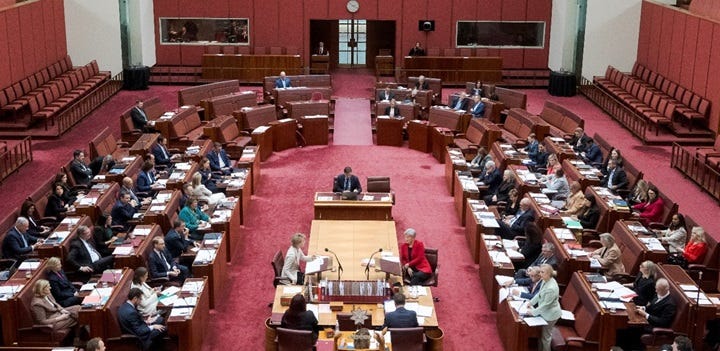
On Tuesday 13 October, the Senate voted on a question most Australians have never been asked: should an aged care home be allowed to decline to provide voluntary assisted dying to the people who live there?
The answer was no.
The proposal, put by One Nation senator Malcolm Roberts, sought to give aged care providers the right to refuse VAD services to residents in their care. It went to a conscience vote, and the result cut across party lines. Five Liberal senators, Jane Hume, Anne Ruston, Andrew Bragg, Maria Kovacic and Richard Colbeck, joined the Greens and most of Labor to defeat it, along with crossbenchers Jacqui Lambie and David Pocock. Supporters included One Nation, Labor senator Raff Ciccone, Liberal senators Michaelia Cash and Sarah Henderson, and Nationals leader Matt Canavan.
The vote passed with barely a headline. It deserved more.
Why the question moved to Canberra
NSW had this argument first. Last year, Liberal MLC Susan Carter introduced a bill that would have let residential facilities decline to facilitate VAD in the same way, and subject to the same obligations to make alternative arrangements, as hospitals. Hospitals in NSW already work this way. The Legislative Council voted it down at second reading on 19 November 2025.
Before that vote, Go Gentle Australia released a legal opinion arguing the bill was invalid because federal aged care law already requires providers to recognise and address residents’ end-of-life care preferences. If that reading holds, no state parliament can give aged care homes a choice about hosting VAD. Only the federal parliament can.
Last week, the federal parliament declined to.
What happens next
Greens senator Sarah Hanson-Young told her party room the vote might be a test of how her own bill to allow VAD via telehealth will fare. The same week, Go Gentle founder Andrew Denton used a National Press Club address to launch a research fund whose second project will investigate institutional obstruction, where it occurs and its impact on patients. Go Gentle says only seven of the 70 largest aged care providers it surveyed offer full access to VAD.
The direction is clear. Homes that would prefer not to host assisted dying are now a problem to be researched and corrected.
A home is shared
The case for requiring every aged care home to facilitate VAD is usually made around one person: the dying resident. Their wishes matter. An aged care home is also home to dozens of other people, though. Many are frail. Many live with cognitive decline. Many feel keenly what their care costs their families and the system.
Some of those residents chose their home because of what it stands for. Wanting to spend your final years somewhere that will never offer death as part of care is an end-of-life choice too. When every provider must facilitate VAD on site, that choice disappears for everyone who would have made it.
The NSW Act names both concerns. Among its principles: all persons, including health practitioners, have the right to have their culture, religion, beliefs and values respected, and there is a need to protect people who may be subject to pressure or duress. A system with room for different kinds of homes keeps both promises.
The bigger gap in aged care
Under NSW law, every person seeking VAD must be told about all the palliative care and treatment options available to them. That safeguard only works if the care is actually there.
For aged care residents it often isn’t, or it arrives late. National data shows older Australians with predictable deaths typically first receive specialist palliative care just 12 days before they die, and people in aged care homes are the least likely to receive it. In Queensland, around one in five people who accessed VAD between April and June this year had never received palliative care.
A resident who is well cared for, free of pain and not made to feel like a burden is making a very different decision from one who is not. If parliaments want to improve how people die in aged care, that is the place to start.
What to watch in NSW
In 2024–25, 8.5 per cent of people in NSW who died after taking a VAD substance died in residential aged care or disability care. Two reports will show where this is heading. The statutory review of the NSW Act is due to be tabled in Parliament by November 2026, and its four themes include safeguards for patients and healthcare workers. Its scope is explicit: it will strengthen the VAD model and will not consider whether VAD should exist at all. The VAD Board’s 2025–26 annual report is due the same month.
Federally, watch Hanson-Young’s telehealth bill. Last week’s vote suggests the Senate is ready to hear it.
Want these updates in your inbox? Subscribe to get our weekly reporting on life issues in Australia, and share this with someone who has a parent or grandparent in aged care.
References
NSW Parliament: Voluntary Assisted Dying Amendment (Residential Facilities) Bill 2025
Go Gentle Australia: Susan Carter must withdraw invalid VAD bill
The Weekly Source: Andrew Denton outlines next wave of VAD reforms
AAP via Newcastle Herald: Barriers remain in voluntary assisted dying access
NSW Health: Background paper: NSW VAD Act legislative review
NSW Health: NSW Voluntary Assisted Dying Legislative Review
Palliative Care Australia: Latest data reveals older Australians only receiving palliative care in last days of life
Queensland Health: VAD Quarterly Report, April to June 2026
Found this valuable? Help us reach more Australians.
Subscribe to Right to Life on Substack for weekly articles, analysis, and commentary:
Support our work: Every donation helps us protect human life and change Australian culture.